
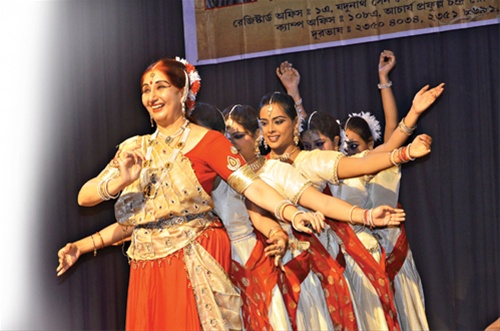
 Amita Dutt, a disciple of Pt Birju Maharaj, Pt Vijay Shankar and other maestros of Kathak gharanas, is a well-known name in classical dance. The director of the Performing Arts Therapy Centre at Rabindra Bharati University, scholar and dancer-choreographer also works for social causes and uses dance for therapy. She will be performing in Pune this Sunday as part of the three-day Nritya Sabha festival to be held at Tilak Smarak Mandir from Nov 8. She spoke to Vrunda Juwale about Kathak, her approach to dance and more. Excerpts…
You have been performing Kathak for the past two decades. From being a shishya of Pt Birju Maharaj to being a guru yourself, how has the journey been? What kind of changes have you witnessed in classical dance and Kathak?
Now students are more focused on making dance into a career. We did it for the love and passion towards the art. Personally, I feel that our generation has been very lucky as we have received a great deal of respect from the audience. A generation or two ago, dancers were treated with contempt and looked on as women who were easily available. In our generation, artistes came from educated, elite families, so they could articulate the message of their art. A career in dance does not only mean that you dance well. You have to be a good communicator and have the audience within your grasp. Again, you have to be innovative while still remaining within the tradition.
I have always innovated within the classical format. I believe new creations enhance the tradition and make classical dance style richer. I have created ‘Chitra Jhankar’ — a production in which all the items are Kathak creations on celebrated classical Hindi film songs such as Jhanak jhanak payal baaje, Garajata barasata sawana ayo re, Keteki gulab juhi champaka bana phule. This has been a real crowd puller and even Pt Birju Maharaj appreciated it, stating that the use of well-known film songs does not make a production ‘filmy’.
I have also created a stage show called Durga and an entire production on Tagore’s Maithili and Braja Bhasha songs, which portrays the Radha-Krishna theme. I have even used western classical music such as The Blue Danube’and Vivaldi’s Four Seasons’for my Kathak dance presentations.
Your present passion is to establish the Bengal Gharana of Kathak. Can you elaborate?
Bengalis, by nature, are romantic, imaginative and lyrical. In Bengal, Kathak has turned more towards graceful presentations rather than acrobatic movements. The main focus is on expressive and graceful delineations. I have extensively employed songs of Bengali lyricists like Tagore, Kaji Nazrul Islam, Dwijendralal Roy and also Bengali kirtans. The style is definitely mainstream Kathak, but it has a distinctive flavour of its own. I, my disciples, and their disciples follow this style. Hence, three generations — the requisite for being recognised as a distinctive gharana — is fulfilled.
What’s your take on the healing properties of dance?
We are experimenting with the healing properties of Performing Arts. That said, dance, drama and music can bring a sense of well-being to people. The physical exercise involved in dance makes patients get rid of many ailments, especially those connected with obesity, various types of joint problems and posture defects and pain. The enhanced blood circulation during dance cures and also helps prevent many diseases.
You have performed for several causes. Do you think an artiste must use his art to give back to society?
Every human being receives so much from society, so we should give something in return. I have served society through my dance.
I have performed for the ailing and dying at Mother Teresa’s Old Age Home in Kolkata, other old-age homes and homes for the mentally and physically handicapped.
I have also given fundraiser performances for the Red Cross, Rotary International, Lions, Governor’s and Chief Minister’s Relief Funds and so on.
You have started teaching Kathak through TV and the web. Do you believe new media should be increasingly used for propagating dance?
We should take advantage of the new innovations. That said, teaching on the web or TV has its shortfalls, like we cannot see the students and hence cannot correct their mistakes. I take about five of my direct students and teach them and this teaching is recorded and telecast. Many possible mistakes are discussed and methods of rectification offered. It may not be the best method of learning, but it is better than no learning at all. Talented students can pick up well.
In Pune this Sunday, you will be giving a presentation on Tagore’s role in propagating dance. How do you intend to make it interesting for the younger audiences?
I will give a Power Point presentation on Tagore’s contribution to dance and also discuss how he viewed dance. It is Tagore who gave recognition and respectability to dance and he was the first to start the institutional training of dance. It is because of him that dance has become a part of our mainstream society and is practised in educated and elite families. To him, dance was the cosmic energy that kept the universe moving.