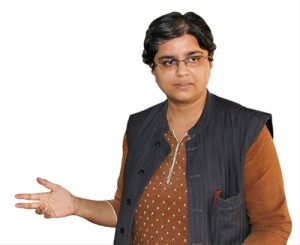
 Dr Priyadarshini Karve, who has won several awards for her eco-friendly innovations, shares with Tania Roy a few ideas on adopting a green lifestyle
Climate change is irreversible, but can we scale down the magnitude of the problem? Yes, we can. If we can reduce our carbon output, find more sustainable ways to development and adopt low-impact lifestyles, we can slow down global warming.
Ideally, we can afford to have 2 tonnes or less of carbon dioxide equivalent, emitted per year per person, so that the overall rise in surface temperature of the earth does not go beyond 2 degrees centigrade.
So the first thing you need to know is how much personal impact are you making on this planet? How much carbon footprint are you leaving behind?
Dr Priyadarshini Karve’s Samuchit Lifestyle Workshop, coming up on Saturday, May 4, tells you how to calculate your carbon footprint and offers tips on how to reduce it as well.
Managing Director of Samuchit Enviro Tech Pvt Ltd Karve has developed a less complicated carbon footprint calculator, which is more appropriate for Indian lifestyles. “Most of the other carbon footprint calculators are focussed on Western lifestyles. The one that I have come up with helps you estimate your carbon dioxide equivalent emissions with the help of five simple inputs including your electricity bill, LPG consumption, petrol/ diesel consumption, carpet area of your apartment and the amount of organic waste at your home,” says Karve, who has been helping people opt for a greener lifestyle by manufacturing eco-friendly products and offering advice for sustainable development.
A lot of youngsters are willing to connect with the bigger environmental movement. “But there’s little encouragement from parents for aspiring environmentalists ‘because the job doesn’t pay you well’,” adds Karve who has been teaching Sustainable Development and the Influence of Science and Technology on Human History at Symbiosis International University. Along with Green Build, Samuchit also conducts free workshops in schools and colleges.
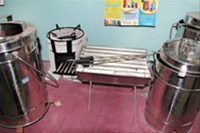
Karve’s first research project with Appropriate Rural Technology Institute (ARTI) led to the oven-and-retort type charring kiln used for converting agricultural waste into charcoal. The technology won ARTI the Ashden Award for Renewable Energy in 2002. While working with ARTI, she invented a number of improved biomass burning cooking devices to reduce smoke in the kitchen and dependence on firewood. Since 2005, her firm Samuchit Enviro Tech Pvt Ltd has been selling a wide range of energy-efficient household devices.
But it’s not easy to design one. “It is more challenging to design an environment-friendly chulha than any other engine because a biogas chulha has to take in different types of fuels whereas a car engine which runs on petrol can take in only one type of fuel. Then again, different organic matter have different burning characteristics and so on,” says Karve.
Selling eco-friendly products is equally tough. “We thought putting up stalls in rural areas would get us customers. We failed miserably. Even though a WHO survey says that an estimated 500,000 women and kids in India die each year by inhaling smoke in the kitchen, rural women are not willing to invest in an eco-friendly chulha! But if the same chulha sells well in urban areas, it finds customers in the rural market because it has an aspirational value. Most of our products like the Sarai cooking system or the portable stainless steel stove have been selling well in cities. Our products are available across India and we are also exporting to Germany,” says Karve, who is coming up with wood-burning stoves in which the smoke emission will be reduced by 80 per cent.
Another initiative that the great-granddaughter of social reformer Maharshi Dhondo Keshav Karve is keen on taking forward is trying to get carbon finance to the grassroots. “Mostly, carbon money is used at the industrial level, but I want it to reach the grassroots,” says Karve, who is soon launching solar lamps with brighter LED lights and better battery too.
So, if you are looking forward to adopting a green lifestyle, you know where to head.
Samuchit’s improved chulhas slash fuel consumption and smoke emissions
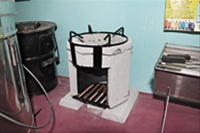
In the Sarai cooking system, beans, rice and vegetables of a family of 4 to 5 can be cooked with just 100 g of charcoal briquettes. It takes between 45 min to an hour to cook a meal
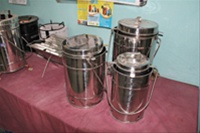
The lightweight Nano Barbeque fits in a carry bag and is easy to assemble and use