
Amanda Lindhout, who spent 460 days in captivity in Somalia, shares her inspiring story of survival. Tania Roy catches up with the humanitarian, activist and writer during her recent visit to the city
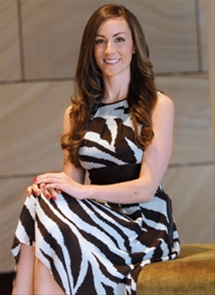 When someone abuses, insults or hurts you, how do you react? You express anger, curse under your breath, scream swear words, seek revenge… That’s how many of you would respond. Forgiveness or compassion would perhaps come last to your mind. Very few people in today’s age practise the art of forgiveness. Interestingly, Amanda Lindhout is one of those few who chooses forgiveness over anger and compassion over hate.
Freelance Canadian journalist Lindhout, along with her photojournalist Australian friend Nigel Brennan, was taken captive in Somalia for 460 days. It is almost three-and-a-half years since she and Brennan were released, but Lindhout says she needs a little more time to heal and marry and settle down. “Of course, I want to marry and have kids, but it will take a while. Right now, I am focussed on healing,” says the 30-something who now devotes the majority of her time to improve the lives of people of Somalia.
Sharing her experiences with young entrepreneurs at the launch of the Pune Chapter of the Entrepreneurs’ Organisation, which is a global network, Lindhout left the audience speechless with her moving and inspiring tale of survival.
‘I had lost the sky, the breeze, the light, the laughter…’
In 2008, Lindhout went to Somalia to know and tell the story of people who were internally displaced. “Before landing, from the airplane window, Mogadishu, the capital of Somalia, looked like a tropical paradise. But it was a different story at ground zero. When we were driving through the city, we saw buildings with bullet holes and deserted streets. There had been intense fighting before we had arrived, we were told,” recalls Lindhout.
She and Brennan were visiting shelters in Somalia when they were taken captive on August 23, 2008. “Brennan and I represented the Western world and my captors, who were between 14 and 18 years of age, felt we had failed them. So they kidnapped us and demanded a ransom. They left a voicemail at my parents’ home and asked for two-and-a-half million dollars,” she says.
But her family was not in a position to pay the amount. So, Lindhout spent the next 15 months in captivity. Although she and Brennan did try to break away, they failed in their attempt, which made matters even worse.
“I spent the next 10 months in total darkness, in a room which had nothing and was pitch dark. I called it ‘The Dark House’. The kidnappers had shackled my legs 24 hours. I was allowed to use the toilet only five times a day, for a maximum of three minutes. It was very difficult to move or sleep with the shackles. I could not sit, I had to lie down. At the most, I could turn on my side,” she shares.
Lindhout was stripped of her identity. Her kidnappers renamed her Amina. “I had lost the sky, the breeze, the light, the laughter and my name, but the most difficult moment was when I had lost faith in human decency. I wondered how people were capable of inflicting so much pain and suffering to another individual. I was not sure whether I could survive the next minute, let alone the day,” says Lindhout who was abused by her captors four to five times a day.
‘My pain was physical, his was a lifetime of misery’
Lindhout was approaching her breaking point when the awakening happened. “One of the boys was hurting me immensely and I was pounding his chest when suddenly I chose to forgive him. I had this out-of-body experience and realised that my pain was mostly physical but his was a lifetime of misery. I saw him as a boy who was an orphan, his sister had been abused and killed, his neighbours massacred, and he had bullet scars and stab wounds. The other kidnappers had similar stories to share,” explains she.
Lindhout had two choices in front of her: She could either stay angry and be in pain, or she could forgive the perpetrators. She opted for the second. “Choosing forgiveness did not make the process easy. What I did is that I started paying attention to the way I was labelling my experiences and replaced them with more empowering thoughts, like, I am free, I believe in the goodness of humankind, I choose to forgive, I choose peace,” she says.
Transforming the lives of Somalis
Lindhout and Brennan were freed in November 2009. When she was released, she could hardly recognise herself. She had bald patches, lost seven teeth and her toe nails were crumbling. “I could slide into a corner or I could put the lessons of forgiveness and compassion to use. I opted to share my story with the world,” says the tall, pretty Canadian who is relentlessly working to transform the lives of Somalis.
In 2010, she established the Global Enrichment Foundation (GEF), a non-profit organisation that engages in education and community-based empowerment programmes. She also returned to Somalia in 2011, putting GEF into the world map after leading famine relief efforts and raising millions of dollars to aid and support more than 175,000 people.
Working with other charitable organisations and academic institutions in Canada, the USA, Somalia and Kenya, GEF has launched six programmes, like providing hope and nourishment to Somalia’s students, providing hope to refugee women, supporting survivors of gender-based violence, providing university scholarships to young women, educating children and supporting women’s literacy and skills training.
Lindhout has also written a book, A House in the Sky, which will see a worldwide September 2013 launch. “It’s the story of my life and my aspirations as a young girl, and later, I talk about my kidnapping and survival,” says Lindhout who has travelled to India several times and wishes to volunteer again for Mother Teresa’s ‘Home for the Dying’ in Kolkata. She loves India, so keeps coming back.