
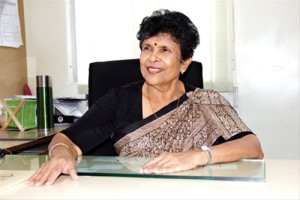
 Dr Anjali Morris tells Mallika Rale why there’s a need for a change in attitude towards children with learning disorders
Look at him, he knows his alphabets already!’ or ‘Wow, she is such a Math wizard’ — the comparison begins very early in life. Bombarded with such comments at home and in school, many children start believing they are lacking in some way if they are unable to excel in these spheres. However, is that really so?
“Absolutely not. But unfortunately, in Indian society, parents want the child to have academic achievements. What they don’t realise is that even if s/he does not do well in academics, s/he will shine in something else, like music or art. The attitude of parents needs to change,” explains Dr Anjali Morris, founder of Dr Anjali Morris Education & Health Foundation in the city.
For the past nine years, Morris Foundation has been raising awareness and working towards bringing about a change. Through its resource teachers and volunteers, the NGO helps children with learning difficulties cope with the challenges they face in school.
A paediatrician who has worked in the US and India for over 30 years, Dr Morris retired from active practice a while ago to concentrate all her energies on this initiative. Says she, “Children with learning difficulties are not slow learners. Yet, we erroneously use the term ‘disability’ while referring to them. Their IQ is not an issue here; just that their brains are wired differently. I found a lot of resistance among paediatricians here as they believe everything is medicine based. But that is not so. In the US, you are bound by the law to help any child who has a learning difficulty. Sadly, there is nothing of the sort here.”
So, how do they work in such a scenario? Dr Morris says, “We approach schools to identify children with learning difficulties and I am happy that right now 19 schools in the city are associated with us. We focus on primary school because there can be 75 per cent improvement if the child is between 6 and 10 years. We start with informal testing in four broad areas of reading, writing and Math.”
The children are assessed individually and based on the findings, structured programmes are developed for them. Moreover, at Morris Foundation, they are encouraged to explore other talents as well. “Teachers from all over Maharashtra and even states like UP, Gujarat and Goa have trained with us,” she adds.
Stressing that parents play a pivotal role in helping a child with learning difficulties, she notes, “Many times, parents drop the kids at our centre and go off to complete their errands. That’s not right. They should be here to know how we deal with the kids so that they can apply those methods at home. After all, this is a continuous process. We definitely want to see more involvement from parents.”
But are we seeing more awareness regarding learning difficulties now? “There certainly is some difference and parents are opening up to the fact that children may not follow conventional career paths. This doctor came to me recently and he was keen that his son follow in his footsteps. But soon enough, he realised that the child may not achieve that level of academic excellence. He enrolled the boy for classical music and he is doing really well. Now, the doctor tells other parents not to stress their children with ‘academic’ expectations. He has become an ambassador for us,” smiles Dr Morris, before signing off.